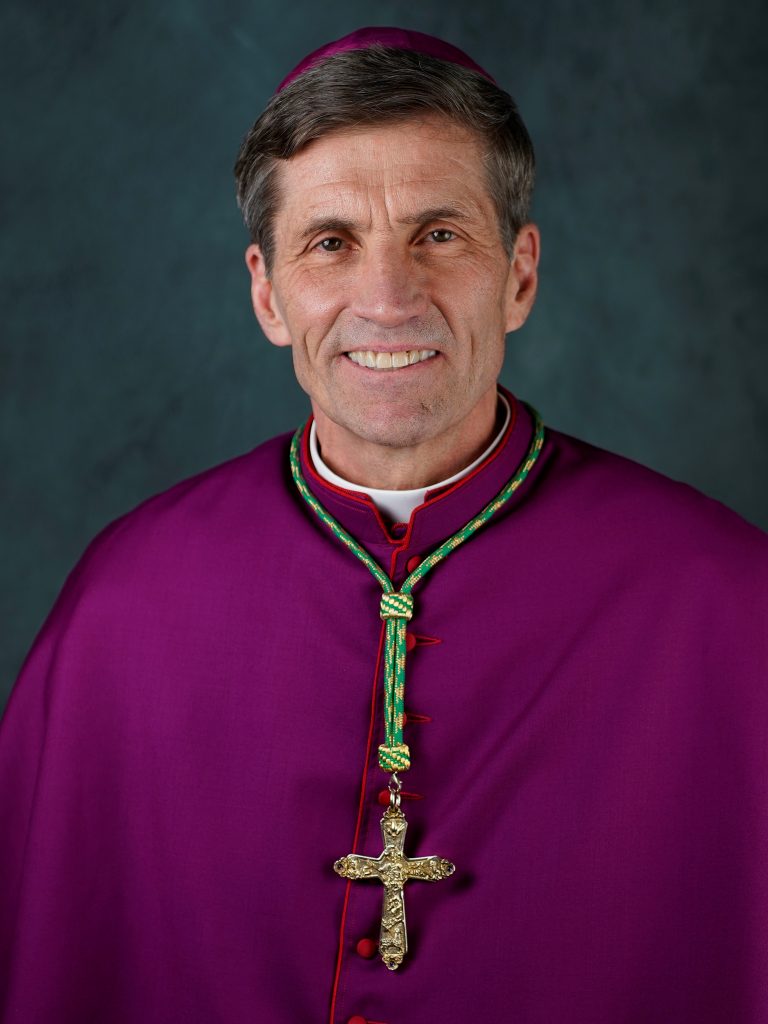
Most Reverend William E. Koenig, M.S.W., D.D. Bishop of the Catholic Diocese of Wilmington
Street Address: 1925 Delaware Avenue, Wilmington, DE 19806 Phone: (302) 573-3100 Fax: (302) 573-6817 Email: bishop@cdow.org
On April 30, 2021, the Holy See announced that the Reverend Monsignor William Edward Koenig, a priest of the Diocese of Rockville Centre, New York, had been appointed the new bishop of the Catholic Diocese of Wilmington. He succeeded the Most Reverend W. Francis Malooly, D.D., who in keeping with canon law offered his resignation to the Holy Father when he turned 75 years of age.
Bishop Koenig was ordained to the Episcopacy by the Most Reverend William E. Lori, Metropolitan Archbishop of Baltimore, and installed as the 10th Bishop of the Diocese of Wilmington at a Mass on Tuesday, July 13, 2021, at St. Elizabeth Church, Cedar and Clayton Streets in Wilmington, Delaware.
At the time of his appointment as Bishop of Wilmington, Bishop William Edward Koenig was the Vicar for Clergy for the Diocese of Rockville Centre, New York.
Born on August 17, 1956 in Queens, New York, Bishop Koenig grew up in East Meadow, New York where he and his family were parishioners of St. Raphael’s Church. He attended St. Raphael’s Elementary School, St. Pius X Preparatory Seminary in Uniondale, New York, Cathedral College in Douglaston, New York and the Seminary of the Immaculate Conception in Huntington, New York. After ordination, he also attended Fordham University from which he received a Master of Social Work Degree.
Bishop Koenig was ordained to the Priesthood by the Most Reverend John R. McGann at St. Agnes Cathedral on May 14, 1983. His first assignment as a priest was to the Parish of St. Edward the Confessor in Syosset, New York. After five years at St. Edward’s, he served for one year in the Parish of St. James in Setauket where he also assisted in the Campus Ministry Program at State University of Stony Brook. In 1989, he was appointed the Diocesan Director of Vocations with Residence at the Cathedral Residence of the Immaculate Conception in Douglaston, New York. As a resident, he assisted the staff of four other priests in helping to form seminarians from the Dioceses of Brooklyn and Rockville Centre for the Priesthood as they completed college or Pre-Theology requirements. In 1990, Bishop Koenig was assigned as Diocesan Director of Ministry to Priests while continuing to serve as Diocesan Director of Vocations. Upon the completion of his assignment in 1996 as Directors of Vocations and Ministry to Priests, Bishop Koenig served from 1996 to 2000 as Parochial Vicar at St. Agnes Cathedral in Rockville Centre, New York. In 2000, he was appointed Pastor of St. William the Abbot in Seaford, New York where he continued to serve until 2009. During his term as Pastor at St. Williams, Bishop Koenig in 2007 was named Chaplain to His Holiness by Pope Benedict XVI. In 2009, he was appointed the Rector of St. Agnes Cathedral in Rockville Centre, New York. His service as Rector concluded in 2020 when he was appointed the Vicar for Clergy for the Diocese of Rockville Centre.
In addition to his Diocesan Assignments, Bishop Koenig has served in a number of roles and Boards in the Diocese of Rockville Centre. He has been the Dean of both the Seaford Deanery as well as the Rockville Centre Deanery. He has been a member of the Diocesan Presbyteral Council and the College of Consultors. He as represented the Diocese of Rockville Centre in the Priests Council of New York State. Bishop Koenig has been the Moderator of CYO of Long Island and is a Board Member of Unitas which serves as an investment corporation for parishes and diocesan entities.
At Easter the Church proclaims the most astonishing news in human history: the tomb is empty and Jesus Christ is alive. What seemed to be the final word—the suffering, death, and darkness of Good Friday—has been overturned by the power of God. It is the beginning of a new creation. Christ is risen and the world and each of us, who through our Baptism enter into the death and resurrection of Christ, are forever changed and, along with St. Paul, proclaim that it is no longer I who live, but Christ who lives in me.
The early Christians knew that this event transformed everything. Back in the fourteenth century an ancient letter was discovered that had been written in the second century by a man identifying himself as a “student of the Apostles.” Often referred to as the Epistle to Diognetus, the letter described the followers of Christ in a remarkable way. Christians, it said, “are indistinguishable…by nationality, language or customs. They do not inhabit separate cities of their own, or speak a strange dialect, or follow some outlandish way of life…with regard to dress, food and manner of life in general, they follow the customs of whatever city they happen to be living in, whether it is Geek or foreign…They pass their days upon earth, but they are citizens of heaven…They live in poverty, but enrich many; they are totally destitute, but possess an abundance of everything. They suffer dishonor, but that is their glory.”
Those early Christians knew that Christ’s resurrection meant they could live in this world without being captive to it. They were, after all, “citizens of heaven.” That same life of faith is entrusted to us. Today we too, as individuals and as a Church, are called to live the same beautiful paradox described in that ancient letter: to participate fully in the activity of the world and yet also know that our true citizenship is in heaven.
Easter is not just an invitation to celebrate a long-ago event, but to live differently. It calls us to be people of hope in a culture often marked by anxiety. It calls us to forgive when resentment seems easier. It calls us to serve when indifference is tempting. The world today needs that witness as much as the ancient world did. Like the Christians described in the Epistle to Diognetus, let us be people whose lives reflect the light of the Risen Christ.
My prayer for you this Easter is that the joy of the Resurrection will fill your homes, strengthen your families, and renew our entire Diocesan Church. May we live as a people who know that Christ is alive and that his victory is already at work among us.
Happy and Blessed Easter.
Mensaje de Pascua 2026
Queridos hermanos y hermanas en Cristo,
¡Él ha Resucitado! ¡Él ha resucitado en Verdad!
En la Pascua, la iglesia proclama la noticia más asombrosa en la historia humana: la tumba esta vacía y Jesucristo está vivo. Lo que parecía ser la última palabra, sufrimiento, muerte, y la oscuridad del Viernes Santo ha sido revocado, por el poder de Dios. Es el comienzo de una nueva creación: Cristo ha resucitado y cada uno de nosotros, quienes a traves del bautismo participamos de su muerte y resurrección, están cambiados para siempre. Junto con San Pablo, nosotros proclamamos: No soy yo quien vive, pero es Cristo que vive en mí.
Los primeros cristianos sabían que estos eventos transformaron todo. Una carta antigua, escrita por un estudiante de los apóstoles y a menudo llamada la Epístola de Diogneto, los describe de esta manera: ellos no habitan en ciudades separadas ni siguen modos de vidas extravagantes.
Ellos pasan sus días sobre la tierra, pero son ciudadanos del cielo, viven en pobreza, pero enriquecen a muchos, sufren deshonor, pero esa es su gloria.” Esos primeros cristianos sabían que la resurrección de Cristo significo que ellos podían vivir en este mundo sin estar cautivos por el mundo. Ellos eran después de todo, ‘ciudadanos del cielo.”
Esa misma vida de fe nos está confiada a nosotros. Hoy, también somos llamados a abandonar esa hermosa paradoja, a participar plenamente en la vida del mundo, y saber que nuestra verdadera ciudadanía está en el cielo. La pascua no es solo una invitación a celebrar un evento del pasado, pero si a vivir, diferente. Nos llama a ser personas de esperanza en una cultura marcada por la ansiedad y perdonar cuando el resentimiento parece ser más fácil y servir cuando la indiferencia nos tienta.
El mundo de hoy necesita ser testigo tanto como el mundo antiguo lo fue. Como esos primeros cristianos descritos en la epístola de Diogneto, puedan que nuestras vidas reflejen la luz del Cristo Resucitado. Mis oraciones por ustedes en esta Pascua, es que la alegria de la Resurrección llene sus hogares, fortalezca sus familias, y renueve nuestra iglesia diocesana. Vivamos como personas queconocen que Cristo está vivo y su victoria ya está trabajando entre nosotros.